Yashera Raddalgoda
Senior Associate Adviser
When Giants Stumble: Nvidia, Scandal and the Long-Term Investor
23 Nov 2026

Nvidia designs specialised chips that power artificial intelligence and is often called the ‘central bank of AI’. Valued at around US$4 trillion, it is one of the world’s most valuable listed companies and one of the largest holdings in global share indices.
On 8th November, Nvidia’s board announced an independent investigation into reports that co-founder and chief executive officer (CEO) Jensen Huang had been the target of a foreign intelligence effort. Four days later, on 12th November, Huang resigned, effective immediately, and Chief Financial Officer Colette Kress was named interim CEO. In a statement posted after his departure, Huang acknowledged, “I have made serious mistakes in my personal life.” The board has since begun searching for a permanent CEO from internal and external candidates.
Nvidia shares fell as much as 9% on the first trading day after the investigation was announced, and as much as 14% on the day of the resignation.
For one of the world’s largest companies, losing its founder of 33 years raises an obvious question for investors: what happens next? History offers no forecast, but it does offer perspective.
The first test: Nvidia’s results
On 17th November, Nvidia reported its first results since Huang’s resignation. Sales for the three months to 25th October more than doubled from a year earlier to US$115.8 billion, ahead of the company’s own forecast, and Nvidia further expects sales of around US$130 billion next quarter. Analysts viewed the results as a positive indication of the company’s near-term outlook (although it is worth noting that results relate to a period prior to the leadership change).
Despite these strong results, the share price has yet to recover, suggesting investors may be waiting for clarity on the company’s future leadership.
Giants have stumbled before
In an age of constant news coverage, a story like Nvidia’s can feel unprecedented, but it is easy to forget that market giants have stumbled before.
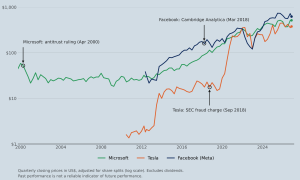
Microsoft, 2000. Shares fell 14.5% in a single day after a US court ruled the company had broken antitrust law. Hit further by the dot-com crash, the stock later recovered and still remains one of the world’s most valuable businesses.
Facebook, 2018. Shares fell almost 7% on the first trading day after the Cambridge Analytica data scandal broke, and around US$50 billion was wiped from the company’s value over two days. Within four months, the shares were trading at record highs.
Tesla, 2018. Shares fell 13.9% after US regulators charged, Elon Musk with fraud, then recovered sharply once a settlement kept him as chief executive.
What history suggests
As outlined in the chart above, initial reactions to scandal are often sharp, reflecting uncertainty rather than a considered view of long-term value.
Over time, the strength of the underlying business mattered more than the headlines and recovery times ranged from months to many years, and certain markets were reassured where founders stayed.
Whilst there are examples of companies that survived, Enron, WorldCom and, closer to home, HIH Insurance collapsed following their scandals, wiping out shareholders. It is important to understand that past performance is not a reliable indicator of future performance, and history cannot tell us how Nvidia’s story will unfold.
The long-term view
Nvidia’s story is attracting a lot of media coverage, and the urge to act on it is natural. Whilst we do not know how it will unfold, the examples above show how quickly the noise of a single week can fade against the long-term trend. In moments like these, it helps to look past the headlines at the business itself. Does it retain its competitive advantage? Will sales momentum continue and result in future profits? Will new leadership give investors confidence in the quality of its leadership and governance? These fundamentals tend to change far more slowly than the news cycle and fund managers, for their part, have taken differing views on the risks and opportunities the situation presents.
That uncertainty is why diversifying investments across many companies, sectors and asset classes matters, because no single company is immune to setbacks. Most Australians already hold Nvidia indirectly through their superannuation, alongside hundreds of other companies, so a fall in any one share is cushioned by the rest. Zooming out, tuning out the noise and sticking to a diversified plan is one of the most valuable decisions an investor can make.
Periods of market uncertainty reinforce the importance of having an investment strategy built around your individual objectives, risk tolerance and long-term financial goals. At Hewison Private Wealth, our independent Wealth Advisers combine disciplined investment management with personalised advice to help clients navigate changing market conditions and make considered investment decisions.
If you’d like to review your portfolio or discuss your investment strategy, we’d welcome the opportunity to start a conversation.