Yashera Raddalgoda
Senior Associate Adviser
Compound Interest: The 8th Wonder of the World?
24 Aug 2026

Albert Einstein is often credited with describing compound interest as the ‘eighth wonder of the world’, adding that “he who understands it, earns it; he who doesn’t, pays it.” This sentiment continues to hold true, as compounding rewards patience more than skill, timing, or luck.
Simply, compound interest is interest earned on interest. The initial investment generates a return, and that return in turn generates further returns. Given sufficient time, the growth path ceases to be linear and begins to rise steeply. This is where “time in the market” becomes more powerful than “timing the market.” The lesson is not spotting the perfect entry point but rather staying invested and starting as early as possible.
A worked example: starting in your 40s vs your 50s
Consider two people, both planning to retire at age 60, who each decide to add an extra $15,000 a year into an investment portfolio.
Sarah starts at age 40, giving her contributions 20 years to compound and Mark waits until age 50, giving him only 10 years. Assuming a 7% average annual return:
· Sarah’s extra contributions grow to roughly $615,000 by age 60.
· Mark’s extra contributions grow to roughly $207,000 by age 60.
Both contributed the same amount each year. The only difference was when they started and yet Sarah’s extra contributions ended up being worth almost three times as much as Mark’s by retirement.
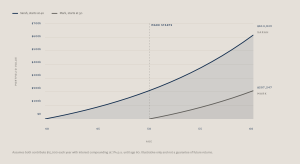
The above graph illustrates this clearly. Sarah’s extra contributions accelerate noticeably from her early 50s onward, as a larger base of accumulated growth compounds further. By Starting at age 50, Mark does not have sufficient time to benefit from compounding and reach the same trajectory before retirement.
How much of Sarah’s balance is contribution, and how much is growth?
By age 60, Sarah has personally contributed $300,000 ($15,000 a year for 20 years). The other $315,000 is growth, or around 51% of her final balance, which is money she never put in herself. In other words, compounding produced slightly more than half of the final balance, and more than Sarah contributed herself.
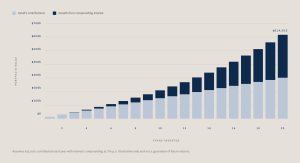
Mark’s split looks very different. He contributed $150,000 over his 10 years, and growth added roughly $57,000 or around 28% of his additional balance. So, Sarah contributed twice as much as Mark but earned more than five times the growth. The larger the base, the more each year’s return adds in dollar terms, which is why the curve steepens near the end instead of climbing at a steady rate. It also explains why the years you can least afford to skip are the earliest ones as they are the years that build the base everything else compounds on.
The takeaway
The closer you are to a financial goal, the less time your contributions have to grow. Sarah’s advantage came not from a higher return or better market timing, but from an additional decade in the market. Compounding is not a strategy that can be accelerated, it can only be given time.
This case study is illustrative only, based on a fixed 7% p.a. return, and does not account for fees, inflation or tax. It is general information, not personal financial advice.